Last updated November 18, 2026







Free written scope consultation - allowances, timeline, and change-order rules on paper before a single trade is scheduled
Bathroom Remodeling Maintenance Schedule: What to Do and When
Most bathroom remodels show their first signs of failure not from bad workmanship but from zero post-installation maintenance. Caulk that gets ignored for 18 months. Grout that never gets sealed. An exhaust fan that clogs silently while you’re sleeping. In our experience across Henderson, we’ve walked into bathrooms ten years old that are already failing and bathrooms twenty years old that still look new, and the difference almost always comes down to whether anyone followed a maintenance schedule in the first two years. This guide gives you a month-by-month calendar tied to the materials and systems installed in your remodel, so your investment holds its value instead of quietly degrading.
Quick Answer
The most critical bathroom maintenance window is the first 30 to 90 days after a remodel: re-seal all caulk joints once they’ve fully cured, apply a penetrating sealer to grout and natural stone, and clean your exhaust fan for the first time. After that, follow a quarterly sealing and cleaning schedule for grout and stone, annual maintenance on caulk and the exhaust fan, and a full fixture inspection every two years. In Henderson, hard water means you should shorten every timeline you’d find in a national maintenance guide by roughly 30 percent.
Styles & brands we work with
- Kitchen remodeling
- Bathroom remodeling
- Home additions & ADU
- Roofing
- Windows & doors
- Driveway & pavers
- Fence
Table of Contents
- The 30-60-90 Day Window: What Most Homeowners Skip
- Material-Specific Maintenance: Porcelain, Natural Stone, and Quartz
- How Henderson’s Hard Water Accelerates Wear
- The Exhaust Fan Window That Determines Your Future
- Month-by-Month Maintenance Calendar
- Annual and Biennial Deep Maintenance
- How the 730-Day Done Right Promise Intersects With Owner Maintenance
- What We See in Henderson Neighborhoods
The 30-60-90 Day Window: What Most Homeowners Skip
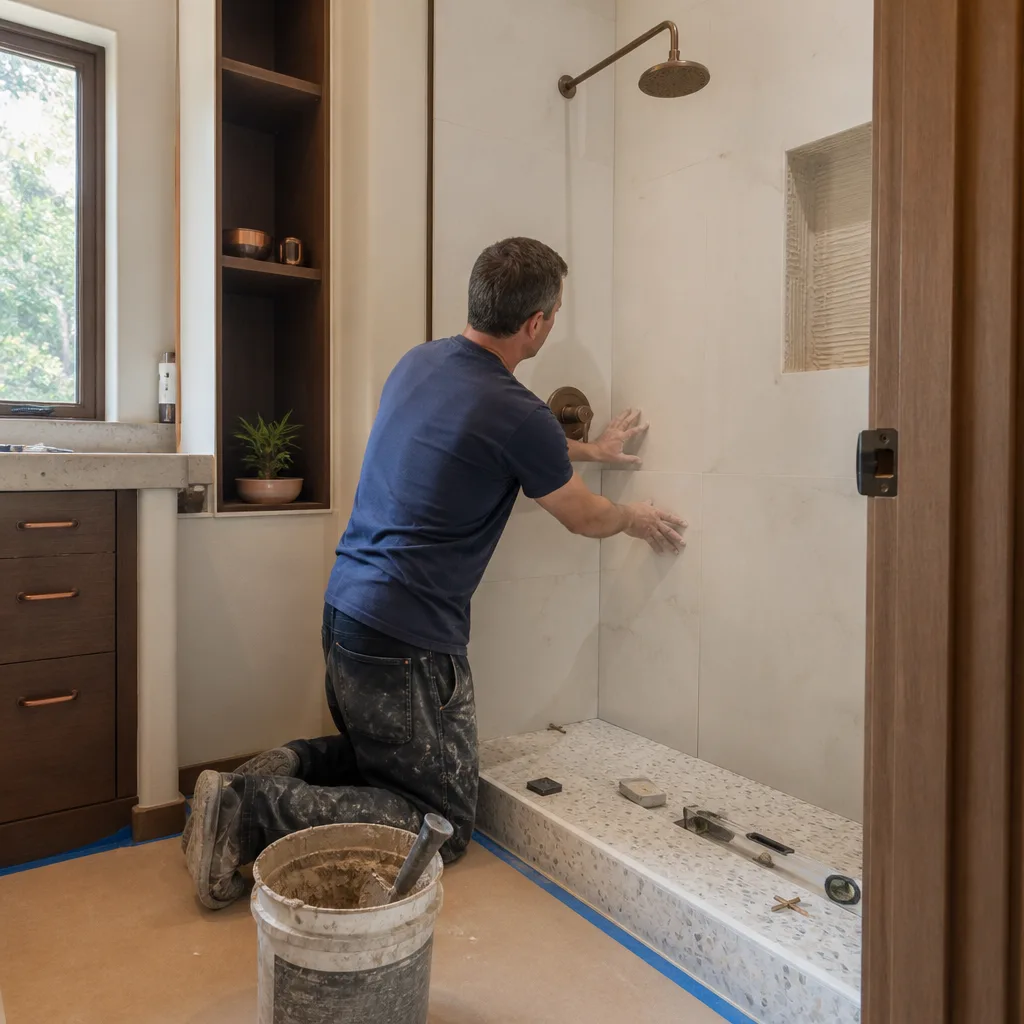
The single most common mistake we see in Henderson is assuming a remodel is “done” when the punch list closes. It isn’t. The 30-60-90 day window is when every newly installed material begins its life, and it’s also when nearly all maintenance opportunities get missed. Here’s why this window matters and what to do inside it.
When fresh caulk is laid down, it needs to fully cure (usually 7 to 14 days depending on the product) before it hits its first cleaning. Sealers on grout and natural stone need a completely dry substrate, which means the shower shouldn’t be used for 24 to 72 hours after application depending on the sealer chemistry. Exhaust fans pull in construction dust and drywall particulate during the tail end of a job, so their first cleaning should happen sooner than the yearly default.
Here’s the 30-60-90 plan we recommend to every homeowner after a bathroom renovation wraps:
- Day 1-7: Let the caulk cure completely. Avoid cleaning the shower with anything but warm water and a soft cloth.
- Day 14: Apply penetrating sealer to any unsealed grout or natural stone. Wipe off excess immediately.
- Day 30: First full exhaust fan cleaning (dust off the grille, vacuum the blades). Inspect all caulk lines for gaps.
- Day 45: Second coat of sealer on shower floors and any grout lines exposed to constant splash.
- Day 60: Check for any re-curing caulk that’s shrunk. Touch up as needed with color-matched silicone.
- Day 90: Do a full walkthrough: check all fixture seals, inspect the base of the toilet, look under the sink for moisture, and test the fan’s actual airflow with a piece of tissue.
That ninety-day sequence is what separates a bathroom that looks great in year ten from one that needs a full refresh in year five. If you’ve just wrapped a remodel in Green Valley or Anthem, start this plan this week. If you’re still in the design phase, ask about it before you hire anyone. More on our Groundwork Construction Co. of Henderson home page for the design side.
Why so few homeowners do this
Most maintenance guides say “regularly maintain your bathroom” and stop there. Newly remodeled bathrooms get special treatment from nobody, because the remodeling contractor is gone and the maintenance plumber hasn’t been called yet. In our experience the gap between those two jobs is exactly where moisture damage, mold, and premature stone staining show up first. It’s a good reason to work with a contractor who walks you through the schedule before you shake hands, and one of the reasons we built our own maintenance handoff into every Henderson bathroom project.
Material-Specific Maintenance: Porcelain, Natural Stone, and Quartz
Not all bathroom surfaces are maintained the same way. A homeowner who treats their marble vanity the same as their porcelain shower tile is going to stain the marble within a year. Here’s how each of the three most common bathroom materials in Henderson homes really works.
Porcelain and ceramic tile
The workhorse. Porcelain is dense, non-porous, and highly stain resistant. That doesn’t mean maintenance-free, but the schedule is forgiving compared to natural stone. Grout is the weak link. Unsanded grout in small joints should be sealed within 30 days of install and re-sealed every 6 to 12 months in showers. Clean with a pH-neutral cleaner, not vinegar, since repeated vinegar exposure etches cementitious grout and eventually opens pinholes where mold takes hold.
Natural stone (marble, travertine, limestone)
Natural stone is porous, softer than porcelain, and reacts with acidic cleaners. If your bathroom uses marble in the shower, on the vanity top, or as a floor, you’ll need a penetrating sealer applied at install, then again at the 30-day mark, then every 3 to 6 months depending on use. In Henderson’s hard water, we recommend every 3 months for shower marble and every 6 months for vanity marble. Clean only with a stone-specific pH-neutral cleaner. Avoid lemon, vinegar, bleach, and any tile cleaner labeled “heavy-duty.”
Engineered quartz
Quartz is non-porous from the factory and generally doesn’t need sealing. It does need something stone and porcelain don’t: heat awareness. Quartz resin can discolor permanently if you set a hot curling iron directly on it. Use a trivet. Clean with a soft cloth and mild soap. For daily use in a Henderson bathroom, quartz is the easiest surface to maintain, which is why we often recommend it for busy primary baths. Brand partners we work with on quartz and stone surfaces include Cambria and Kohler; when we specify the material we also spell out its maintenance schedule in writing before the slab is ordered.
Fixture finishes
Brushed nickel, matte black, chrome, and oil-rubbed bronze all have different care requirements. Matte black is the most sensitive to hard-water spotting and abrasive cleaners. Chrome tolerates more but shows water spots first. Henderson’s water chemistry will test whatever finish you choose, so plan on wiping fixtures dry after each shower with a microfiber towel. It sounds fussy; it’s the single cheapest way to keep finishes looking new.
How Henderson’s Hard Water Accelerates Wear
Southern Nevada’s water supply is among the hardest in the country, running roughly 250 to 350 milligrams per liter of calcium carbonate depending on the source and season. That’s about 15 to 20 grains per gallon. The national recommendation for “hard” water is over 7 grains per gallon. Henderson sits at more than double that, which means every maintenance timeline you find in a generic guide needs to be tightened.
Practically, here’s what that means for a Henderson bathroom:
- Shower glass: Hard water deposits etch glass if left more than 3 to 5 days. Squeegee after every shower, use a daily shower spray, and deep-clean with a mineral-dissolving cleaner (not vinegar on natural stone) weekly.
- Fixtures: Faucets and showerheads need a descaling soak every 60 days, not every 6 months. Showerheads lose 20 to 30 percent of their flow within a year of use if never descaled.
- Grout: Calcium builds in grout lines and makes mold easier to grow. Re-seal showers every 6 months instead of annually. Bathroom floors every 12 months instead of every 2 years.
- Toilets: Hard water scale shortens flapper and valve life. Inspect the tank every 6 months; replace the flapper every 2 years as a preventive.
- Tile showers: Even with good ventilation, mineral deposits can grow crusty biofilm at grout intersections. That’s a spray-and-wipe weekly job, not monthly.
If you’re building or remodeling and want to lighten the maintenance load, ask about a whole-home water softener at the same time. That’s outside bathroom scope, but the two decisions are tightly coupled. If you’re considering a larger remodel that might include the softener loop or an added bath, our Home Additions & ADU in Henderson page covers how we approach that scope.
The Exhaust Fan Window That Determines Your Future
Your bathroom exhaust fan is the hardest-working appliance in the room. A family of four taking showers every morning pumps a cup of water vapor into the air each day. That vapor has to leave the house, or it condenses on every cold surface behind the tile, above the ceiling, and inside the wall cavity. The maintenance window on that fan decides whether you see moisture damage at year two or year ten.
How do you know the fan is actually working?
The tissue test: hold a piece of toilet paper next to the grille while the fan is on. If it doesn’t stick firmly to the grille, the fan isn’t moving enough air. In our experience across Henderson bathrooms, roughly one in three fans we test on a non-remodeled bath fails that test. Usually it’s dust buildup or a fan that was undersized from the start.
The maintenance schedule
- Monthly: Wipe down the exterior grille with a damp cloth. This is a 30-second job and it prevents 80 percent of the dust that reaches the blades.
- Every 3 months: Vacuum the grille from the room side.
- Every 6 to 12 months: Remove the grille (usually spring clips), vacuum the blades and housing, and check that the damper opens freely.
- Annually: Check the duct at the roof or wall cap for lint and pest blockages. If your fan exhausts into the attic rather than outdoors, that’s a code problem that needs fixing regardless of maintenance (more below).
- Every 2 to 3 years: A 20-year-old fan that’s never been cleaned is the most common culprit for recurring mold. Shop fans with 110 cubic feet per minute or higher for a standard bath, higher for larger primary baths, and always ducted to the outdoors.
What the building code actually requires
Per the residential mechanical code adopted in Henderson and Clark County, bathroom exhaust must terminate outdoors, not in the attic or crawlspace. Duct runs should be short, insulated, and sloped so condensation drains back into the room rather than pooling against the roof deck. If a fan runs but the duct is disconnected up top, you get all the noise and none of the exhaust. When we’re in a Henderson home for a remodel and find a disconnected duct from a prior install, we fix it whether or not it’s on the original scope, because leaving it invites the exact damage the fan was meant to prevent.
Month-by-Month Maintenance Calendar
Here’s the schedule we hand every homeowner after a Groundwork bathroom remodel is complete. It works off a rolling 12-month cycle, plus the first ninety days flagged above.
Months 1 through 3 (post-remodel)
- Seal grout and natural stone on day 14, day 45, and touch up at day 90.
- Clean exhaust fan at day 30 and again at day 90.
- Wipe fixtures dry after every shower.
- Do a full leak inspection under sink and around toilet base at day 30 and day 90.
Month 4 through 6
- Re-seal shower grout if you use the shower daily.
- Descale the showerhead and faucet aerators.
- Squeegee glass and check for hard-water spotting on fixtures.
- Clean exhaust fan grille.
Month 7 through 9
- Deep clean shower tile with a grout-safe cleaner.
- Inspect caulk lines around tub, shower pan, and backsplash for gaps or shrinkage. Re-caulk any failure with silicone.
- Check toilet tank for scale buildup and clean.
- Re-seal grout if the shower is used by more than two people daily.
Month 10 through 12
- Clean exhaust fan blades and housing (full removal).
- Inspect the exhaust duct at the roof or wall cap.
- Re-seal natural stone (marble, travertine) if you haven’t in 6 months.
- Deep-clean the entire bathroom: grout lines, behind the toilet, base of the tub.
- Test all GFCI outlets and the exhaust fan with the tissue test.
Annual and Biennial Deep Maintenance
Beyond the monthly and quarterly cycle, some jobs only make sense on a longer horizon. If you do these on schedule, you’ll never face the “well, we’re already remodeling, might as well gut it” conversation that starts a five-figure invoice.
Every year
- Inspect all caulk joints. If you can catch a fingernail in a joint, it’s time to re-caulk. Use 100 percent silicone in wet areas.
- Check grout for cracks, pinholes, and low spots. Re-grout or re-apply sealer as needed.
- Inspect the exhaust fan, duct, and roof cap.
- Test the GFCI outlets with the test button and check the bathroom supply stop valves for drips.
- Check water supply lines under the sink for stiffness or cracking; replace braided lines every 5 years.
Every 2 years
- Replace toilet flappers and fill valves as preventive maintenance.
- Replace shower cartridges on pressure-balance valves if you notice temperature fluctuations.
- Re-caulk the entire wet area if any joint is showing wear.
- Inspect the floor drain or linear drain if you have one.
- Full-fan replacement is usually not needed for 10 to 15 years if maintained, but plan for one replacement eventually.
None of this is exotic. It’s the same care a hotel housekeeping staff does daily, just at a homeowner’s pace.
How the 730-Day Done Right Promise Intersects With Owner Maintenance
Here’s the question we get most from Henderson homeowners after a remodel: does skipping maintenance void the warranty? The short answer is no, but there’s a real distinction between what the 730-Day Done Right Promise covers and what falls to you.
The 730-Day Done Right Promise covers workmanship for two full years. If a tile lifts because the thinset failed, if the shower pan leaks from a bad slope, if a fixture we installed fails in its first two years because of how it was set, we make it right. That promise doesn’t ask you to prove you maintained the bathroom to industry standards, and it doesn’t have a fine-print clause that shrinks the coverage if you forgot to re-seal your grout on day 45.
Where the line falls is between workmanship defects and neglect. Consider two scenarios:
- Scenario A: covered. You shower every day. Nine months after install, a tile hollows because the waterproofing behind it failed. That’s our problem and we fix it under the promise.
- Scenario B: not covered. You let a slow leak drip under a marble vanity for 14 months without ever looking under the sink. When the cabinet swells and the marble warps, that’s damage from an unrepaired leak, and it’s outside the scope of any workmanship guarantee.
Same story with caulk. If a shower pan’s caulk joint separates from the tile in six months, that’s typically a workmanship issue we address. If it separates after 18 months of ignored use, that’s normal caulk wear, which is homeowner maintenance on any bathroom. This is why we put a written maintenance schedule into every Henderson project file. “Built to last, backed in writing” only works if both sides hold up their end, and we’re upfront about which end is ours.
The good news is that the workmanlike part of maintenance is small. Fifteen minutes a month, a full clean-out twice a year, and an honest look under the sink once a quarter covers 90 percent of what prevents big failures.
What We See in Henderson Neighborhoods
Henderson isn’t one water chemistry, one climate, or one housing stock. Where you live changes what your bathroom needs. Some examples from our work across the city:
- Green Valley and Green Valley Ranch: The 1990s and 2000s housing stock means a lot of original bathroom fans now at 25-plus years. Replacing an old fan is one of the cheapest prevention moves in a Henderson bathroom. We see this most often on the older streets of Green Valley.
- Anthem and Seven Hills: Higher elevation means colder winter nights, and poorly insulated bathroom walls create more condensation on tile and glass. These homes need aggressive ventilation maintenance from day one.
- Lake Las Vegas and the southeast valleys: Hard water here is even harder than Clark County’s already-high average, because of the local source mix. Plan on re-sealing stone every 90 days rather than every 6 months.
- Inspirada and Cadence: Newer construction with builder-grade materials means the first major maintenance cycle is usually right at year 5, when original caulk and grout have hit the end of their typical lifespan. Many of these bathrooms benefit from an early full re-seal and re-caulk well before the first sign of trouble.
- Downtown Henderson and older neighborhoods: 1960s and 1970s bathrooms often have original cast iron plumbing, concrete backer that’s failed, and undersized or nonexistent exhaust. Our recommendation for these often includes an inspection of the fan and duct before any cosmetic work, because the moisture problem is upstream of the tile.
For homeowners who are considering a bigger scope, like adding a bath or reworking the exterior to match a remodeled interior, we’ve laid out those details on our Driveway & Pavers in Henderson and Fence Installation in Henderson pages. Belgard pavers and Bufftech or ActiveYards fence systems follow the same logic: choose the material you’ll maintain, not just the one you like on day one.
Common Mistakes to Avoid
- Assuming “no visible problem” means “no maintenance needed.” In Henderson’s hard water, calcium buildup under a toilet valve, crust on a grout line, or dust in an exhaust fan rarely announces itself until it’s already caused damage. Check quarterly whether or not you see a problem.
- Using vinegar to clean everything. Vinegar is fine on porcelain and chrome, but it etches natural stone and over time weakens cementitious grout. In a Henderson home with marble or travertine in the bathroom, vinegar is the wrong tool in a matter of weeks.
- Skipping the 30-day sealer re-application. One coat on fresh grout is not enough. Grout cures slowly and benefits from a second application once the first has fully dried. This is the single biggest reason we see early grout staining.
- Never cleaning the exhaust fan. A clogged fan runs but doesn’t exhaust. The sound is reassuring and the effect is zero. It’s the number one preventable cause of recurrence of mold in a remodeled Henderson bathroom.
- Sealing freshly installed grout before it’s cured. Sealer applied too early traps moisture under the surface and can discolor grout permanently. Wait at least 3 days after install, and 7 for new cementitious grout in high humidity.
- Letting a small caulk gap become a slow leak. A 6-inch gap in shower caulk looks cosmetic. In a wet shower, water wicks behind the tile and eventually rots the backer. Re-caulk at the first sign of separation, not at the first sign of a soft spot.
- Ignoring the water softener conversation. If you’re within six months of a remodel in Henderson, ask your contractor about the water softener loop before walls are closed up. Retrofitting one later costs more and doesn’t help the stone you already installed.
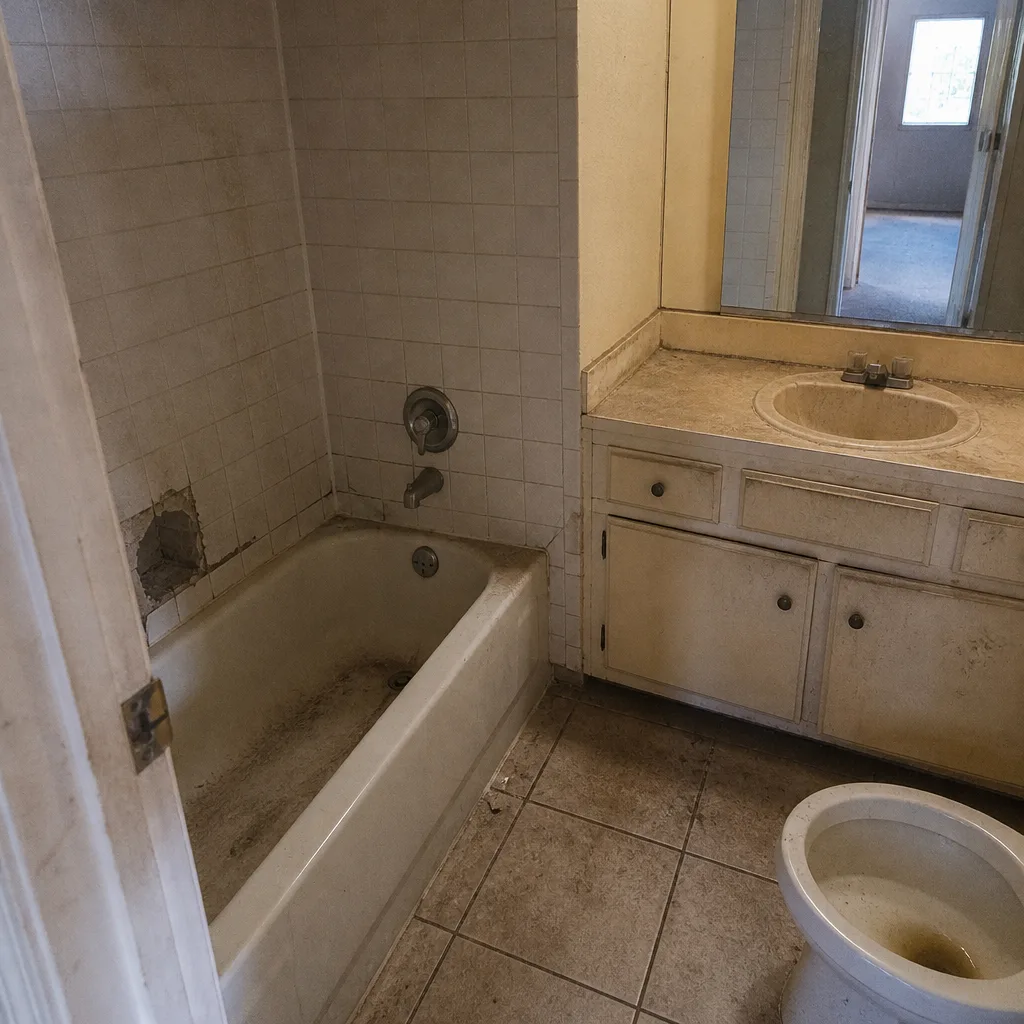
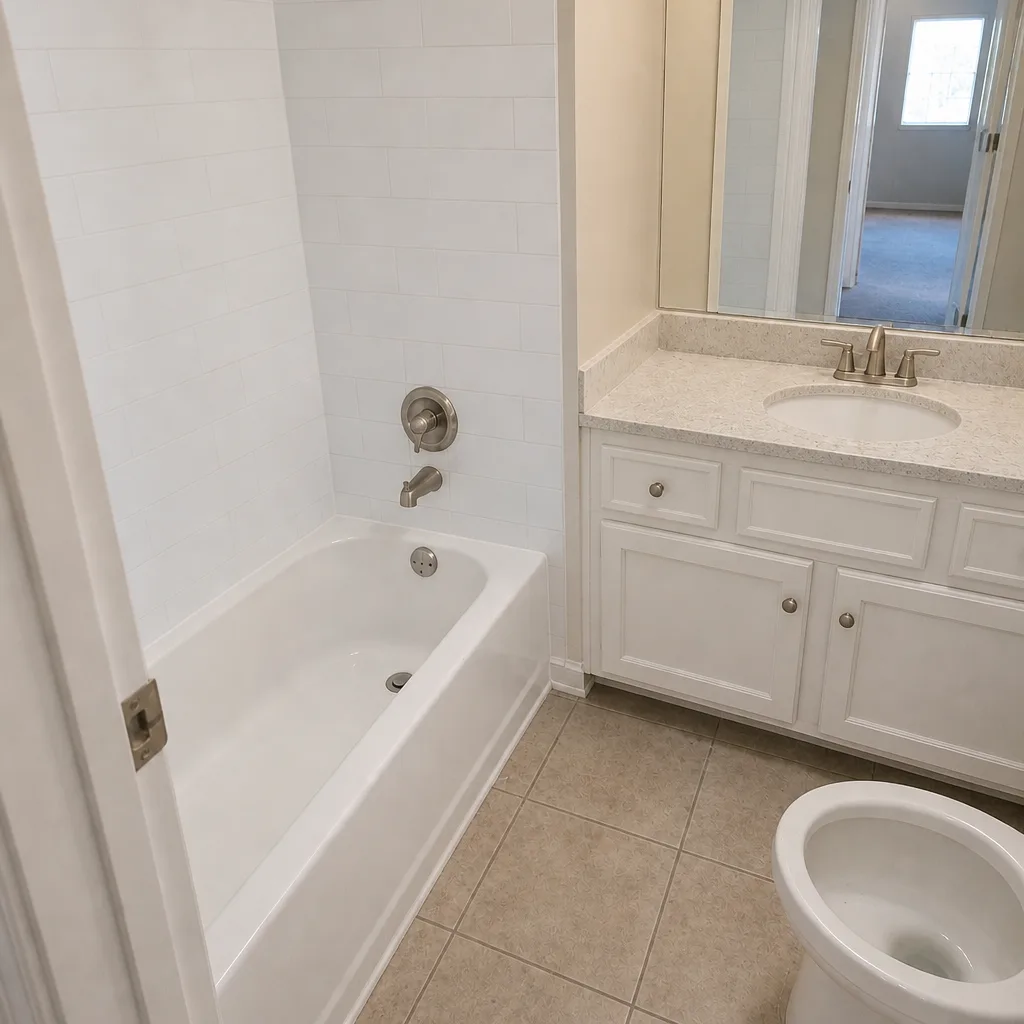
See the difference
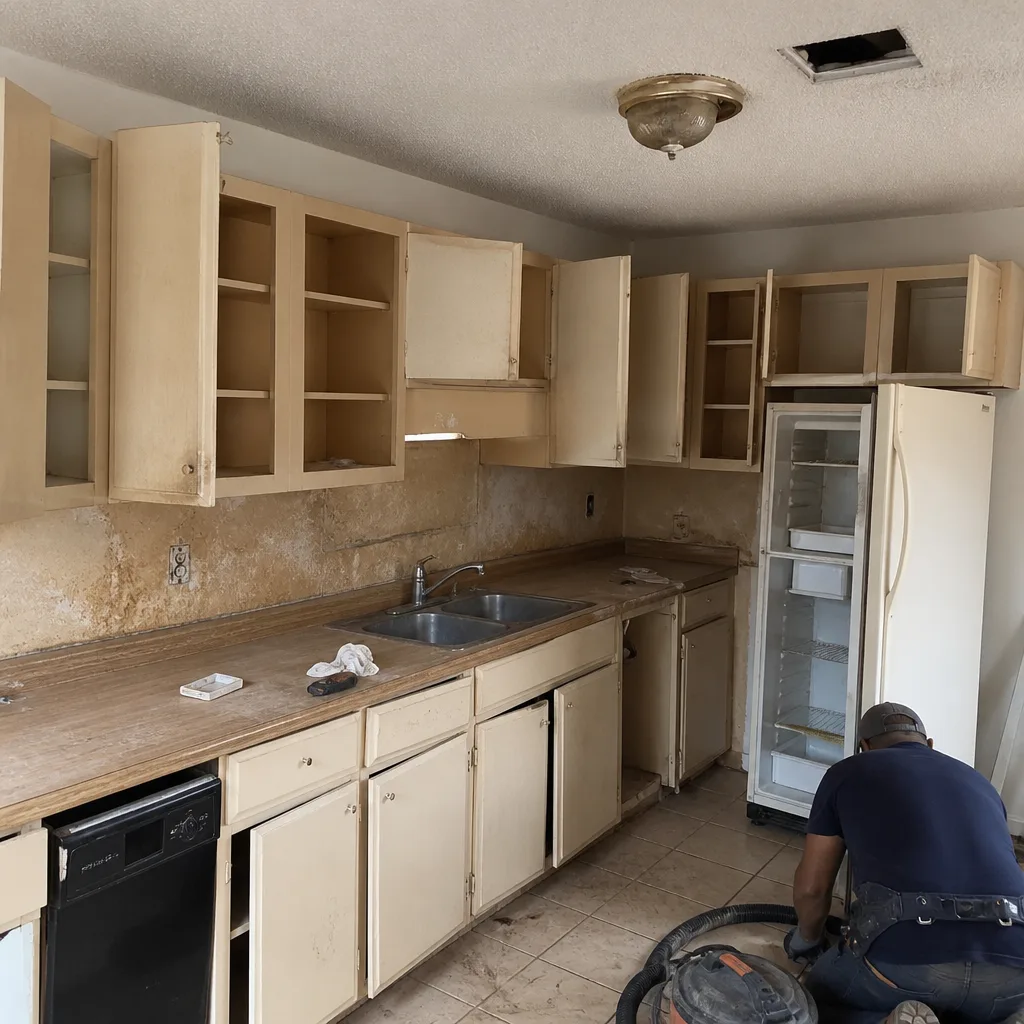 Before
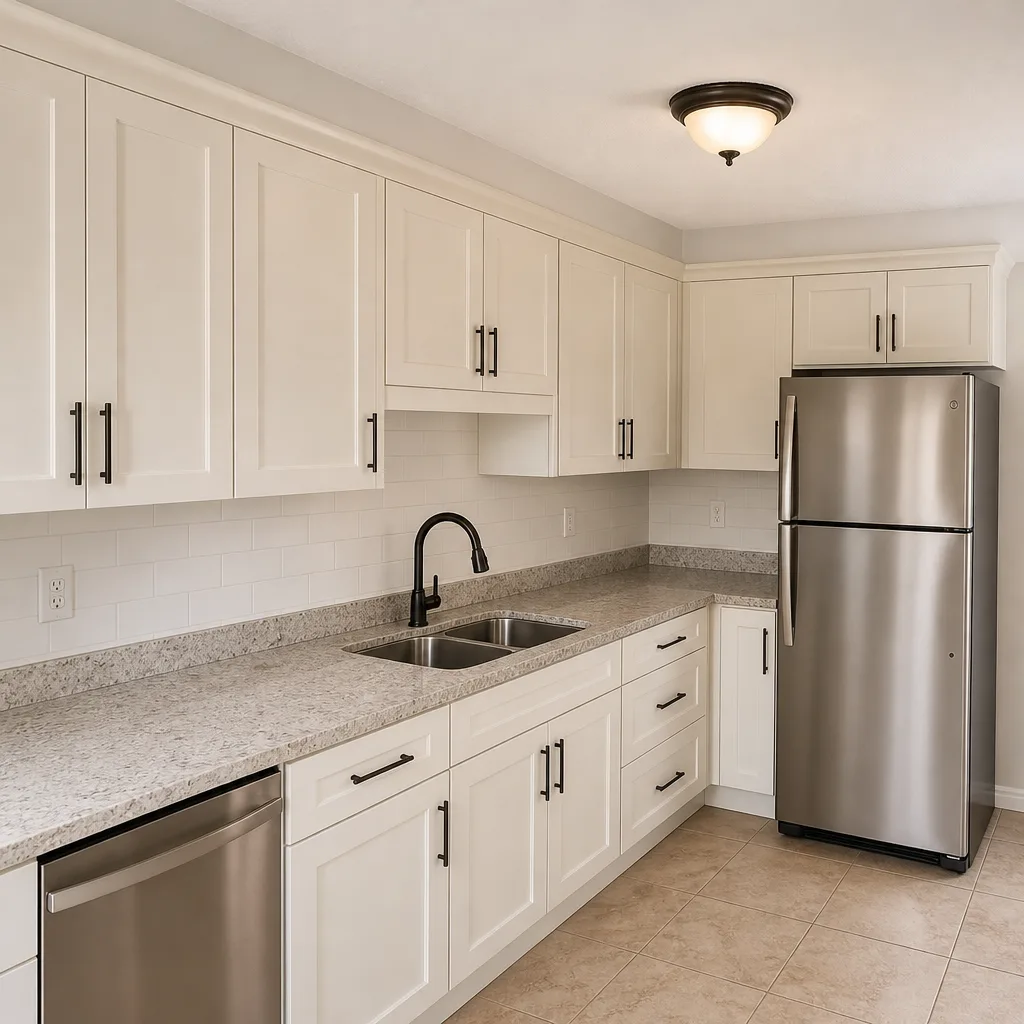 After
 Before
 After
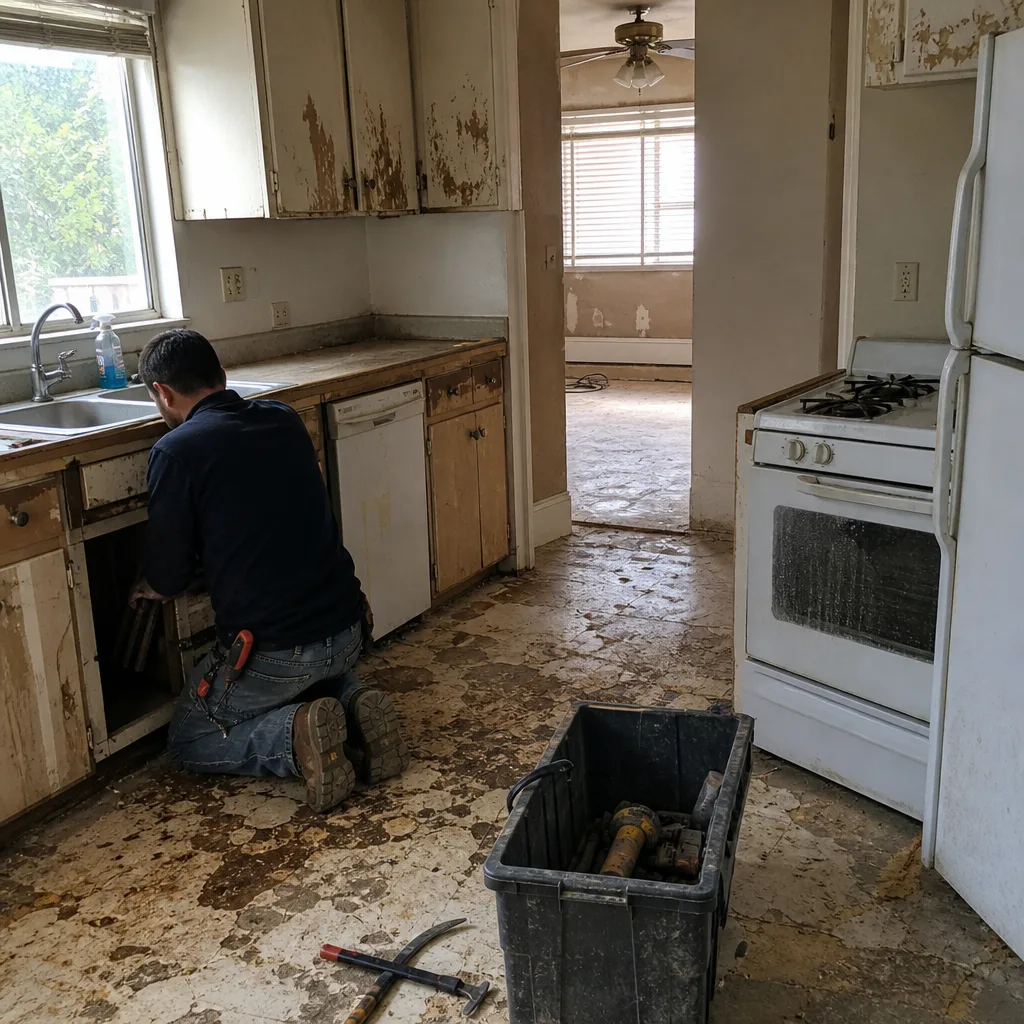 Before
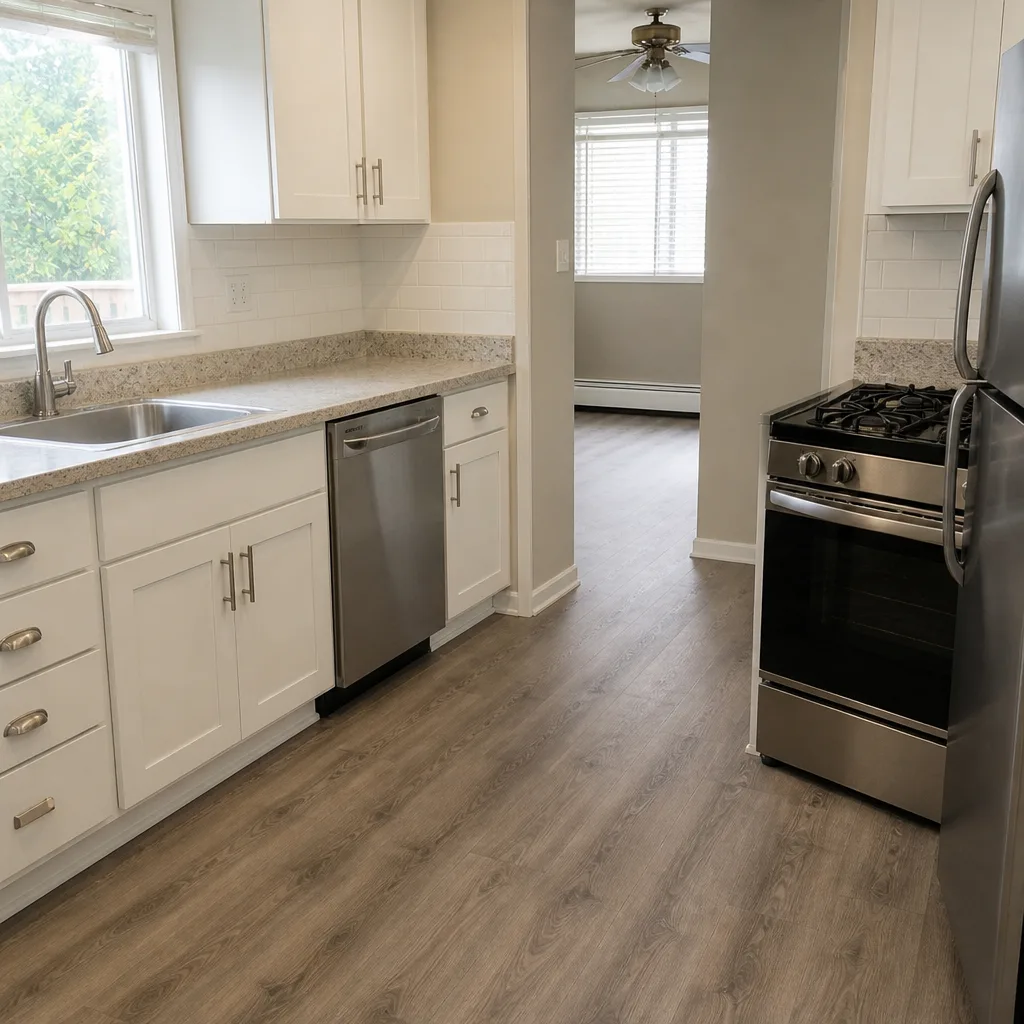 After
When to Call a Professional
Most of what we’ve outlined in this guide is homeowner work: cleaning, sealing, wiping, testing. Some of it isn’t. Call a professional if you see recurrent mold despite consistent fan use, if water is staining a ceiling below the bathroom, if a shower pan doesn’t drain or develops a soft spot, if a fixture needs to be replaced and the shutoff valve behind it sticks or drips, if the exhaust fan needs to be replaced and the existing duct is disconnected or undersized, or if grout or caulk fails repeatedly in the same spot after re-sealing. Those signal a waterproofing problem, not a maintenance problem. Groundwork Construction Co. of Henderson offers free estimates in Henderson and can diagnose whether it’s a fix, a repair, or a full replacement. Call (844) 320-6757. Live person, 24/7, no voicemail black hole.
Frequently Asked Questions
Re-seal shower grout every 6 months and floor grout every 12 months in Henderson, versus the 12 to 24 months most national guides recommend. Henderson’s hard water shortens every sealing interval by roughly 30 to 50 percent. If your shower sees daily use by more than two people, tighten to every 4 to 6 months. Call (844) 320-6757 for a free estimate if you’d rather have a professional handle the sealing and inspection.
Inspect caulk joints at day 30, touch up any shrinkage at day 60, and re-caulk the full shower area every 12 to 18 months. New silicone caulk shrinks slightly as it cures, so a small gap at day 30 is normal. A gap that reopens in the same spot within 90 days is a sign the joint wasn’t prepped correctly. That’s covered under the 730-Day Done Right Promise, and we’ll come out and fix it. Call (844) 320-6757 to schedule an inspection.
The fan is either undersized, clogged with dust, or ducted improperly. Start with a full cleaning of the grille and blades. If that doesn’t fix it, do the tissue test; if the tissue doesn’t stick, the fan isn’t moving enough air. A standard bath needs at least 110 CFM in Henderson’s high-humidity shower cycles, and larger primary baths often need 150 or higher. A disconnected duct at the roof cap is also a common cause. Call (844) 320-6757 for a free diagnostic estimate.
No. The 730-Day Done Right Promise covers workmanship for two full years regardless of your maintenance routine, so a failed waterproofing or bad install is on us even if you skipped a few sealings. What’s not covered is damage caused by unrepaired leaks or neglect, like a chronically leaking valve that ruins a vanity. The promise is built around right work, not perfect maintenance; call (844) 320-6757 with any questions about what’s covered.
A well-maintained bathroom remodel in Henderson can last 20 to 25 years before any full redo is needed. The porcelain, quartz, and quality plumbing fixtures are all built for that long haul. What typically fails first without maintenance is grout, caulk, and the exhaust system, all for under $200 per year to maintain. Call (844) 320-6757 to talk through a remodel or a repair estimate before a minor problem becomes a full replacement.
Clean the existing fan if it’s under 15 years old and passes the tissue test after cleaning. Replace it if it’s more than 15 years old, if it fails the tissue test after a full clean, or if it’s ducted into the attic instead of outdoors. A replacement in a standard Henderson bathroom runs in the low hundreds installed, and it’s the single best defense against moisture damage in the years after a remodel. Call (844) 320-6757 for a free estimate on fan replacement or on any bathroom work you’re planning.
The Bottom Line
Your bathroom remodel is only as good as the two years of care that follow the last tile being set. The 30-60-90 day window matters most: seal at day 14, reseal at day 45, clean the fan by day 30, and touch up any caulk shrinkage as it appears. After that, re-seal shower grout every 6 months, natural stone every 3 to 6 months, inspect caulk annually, and clean the exhaust fan every 6 to 12 months. Henderson’s hard water means every one of those windows should be tighter than the national average. Do this and your bathroom will look new for decades. Skip it, and the failures come faster than you’d expect.
Groundwork Construction Co. of Henderson offers free project estimates and design consultations on every bathroom remodel, and the 730-Day Done Right Promise covers our work for two full years with no fine-print maintenance clauses. We bring background-checked, uniformed technicians, upfront pricing, and one of the longest workmanship guarantees in the residential construction space. Call (844) 320-6757 to schedule your free estimate in Henderson. Live person, 24/7, no voicemail. We’ll write your maintenance schedule into the project file before we hand you the keys.
Written by the team at Groundwork Construction Co. of Henderson.