Last updated November 18, 2026


Free written scope consultation - allowances, timeline, and change-order rules on paper before a single trade is scheduled
Fence Installation Warning Signs Every Homeowner Should Know
A fence that looks perfect on day one can be leaning within a year, and in most cases the warning signs were there before the first post was ever set, hiding in the contractor’s proposal. Here’s the uncomfortable truth we’ve learned from years of building fences across Henderson: the crews that cut corners rarely do it where you can see them. They do it underground, in the concrete, and in the paperwork. This guide walks you through the specific things a contractor says (or refuses to say) that signal trouble, the on-site checkpoints that separate craftsmen from crews in a hurry, and the exact tolerances your finished fence should meet before you hand over the final check.
Quick Answer
The biggest fence installation warning signs are a contractor who won’t discuss utility locates or pull a permit, a proposal that’s vague about post depth and concrete mix, and a crew that sets panels before the concrete cures. In Henderson, our caliche-heavy soil and summer heat punish shortcuts fast, so these red flags show up as leaning posts and cracking footings within a single season. If any of these appear before or during the job, stop and get a second estimate.
Styles & brands we work with
- Kitchen remodeling
- Bathroom remodeling
- Home additions & ADU
- Roofing
- Windows & doors
- Driveway & pavers
- Fence
Table of Contents
- What a Bad Fence Proposal Looks Like Before You Sign
- Why “We Don’t Bother With Permits” Is a Hard Stop
- Post Depth and Concrete Mix in Henderson’s Soil
- Property Line Verification and Who Owns the Liability
- On-Site Red Flags During Installation
- What the Finished Fence Should (and Shouldn’t) Look Like
- The Questions That Expose a Shortcut Crew
- Common Mistakes to Avoid
- When to Call a Professional
What a Bad Fence Proposal Looks Like Before You Sign
The warning signs start in the paperwork, long before anyone digs a hole. A legitimate fence proposal is specific enough that two contractors bidding the same job should look almost identical on paper. When one comes in thousands cheaper, the difference is usually buried in materials, depth, or labor the crew intends to skip.
Here’s what a real proposal spells out: linear footage and post spacing, post depth and diameter, concrete type and volume per post, material brand and grade, gate hardware brand, disposal of old fencing, and whether the permit and utility locates are included. If any of those are missing, ask. If the contractor can’t answer in plain language, that’s your first warning sign.
The proposal red flags we see most often in Henderson:
- A per-foot price with no breakdown. “It’s $32 a foot, all in” tells you nothing about post depth, concrete, or hardware. A line-item quote does.
- No mention of the old fence. Tear-out and disposal is real labor and real dump fees. If it’s not on the proposal, it’ll become a surprise change order.
- Vague material language. “Wood fence” is not a material spec. You want the species, grade, and treatment (for example, cedar versus pressure-treated pine), plus a recognizd brand for vinyl or composite panels such as Boral or PGT where the line calls for it.
- No written warranty. A handshake promise isn’t a warranty. Ask what’s covered and for how long, in writing.
- Cash-only, no paper trail. Legitimate contractors invoice. A crew that wants cash with no contract is asking you to carry all the risk.
Groundwork Construction Co. of Henderson builds every fence quote as a written, line-item document, because upfront pricing with no surprises is the only kind of pricing that protects you. Fence Installation in Henderson covers the full scope of what a proper bid includes.
Why “We Don’t Bother With Permits” Is a Hard Stop
If a contractor tells you permits and utility locates aren’t necessary, treat it as a hard stop, not a minor concern. The permit protects you, not the contractor. It confirms the fence meets height and setback rules for your parcel, and it forces an inspection that catches structural shortcuts before they become your problem. Skip it and the liability transfers to you the moment the crew drives away.
Utility locates are even more serious. Nevada law requires anyone digging to have underground utilities marked before a shovel hits the ground. Every post hole is a chance to hit an irrigation line, a landscape lighting circuit, or worse. A crew that starts digging without a locate ticket is gambling with your property and, in some cases, with their own safety.
What a proper pre-dig process looks like:
- The contractor confirms your property boundaries and reviews the plat or survey.
- They schedule utility locates through the state’s free 811 service and wait for flags to appear.
- They pull the fence permit through the City of Henderson if your height or location requires it.
- They hand-dig or carefully machine-auger near marked lines, never blindly through them.
- They schedule the inspection and don’t hide the results from you.
In Henderson, fence height rules and HOA overlays vary block by block, especially in master-planned communities like Green Valley and Seven Hills. A contractor who works here regularly knows the local height limits without blinking. One who waves off permits has never had to explain a code violation to a city inspector, and you don’t want to be their first lesson.
Post Depth and Concrete Mix in Henderson’s Soil
Post depth and concrete mix are where the invisible corners get cut. This is the part of the job you’ll never see again once the dirt goes back in, which is exactly why it’s the part a fast crew is tempted to short. In Henderson’s soil, that shortcut shows up within a season.
Our local ground is a mix of decomposed granite, sand, and caliche, a cemented layer that’s brutally hard to dig through. Caliche is also a drainage problem: water pools on it rather than soaking away, so a shallow post sitting on top of the hardpan holds moisture against the wood and rots from the bottom up. That’s why we set fence posts well below grade, into the stable soil beneath the caliche layer, with a concrete mix that cures hard and doesn’t crumble under our summer heat swings.
The standards a crew should hit, and the signs they’re not:
- Depth. Posts should be set deep enough to reach stable soil, typically one-third of the post’s above-grade height or more, depending on the material. A crew augering shallow holes and dropping posts in like fence pickets is shorting you.
- Concrete mix. Premixed bagged concrete mixed to the right ratio, or ready-mix delivered in volume. If you see a crew dumping dry powder into a wet hole and stirring with a stick, the mix is wrong and the footing will fail.
- Mixed-bag concrete. Watch for bags from different brands or batches all dumped into one footing. Inconsistent cure means an inconsistent post.
- Dome the concrete. The top of each footing should slope away from the post so water runs off, not into the wood. A flat or dished footing traps water.
- Gravel at the bottom. A few inches of gravel under the post helps drainage. Skip it and the post sits in a puddle every time it rains.
Ask your contractor directly: how deep will the posts go, what concrete are you using, and how many inches of gravel go in the bottom? A pro answers instantly. A shortcut crew changes the subject.
Property Line Verification and Who Owns the Liability
Property line verification is the step homeowners most often don’t know to ask about, and it’s the one that can cost you a neighbor dispute or a legal bill. If the fence goes up two feet onto your neighbor’s lot, the liability falls on you, the property owner, not the crew that guessed at the line.
A proper verification process doesn’t rely on “the old fence was probably here.” Old fences drift. Landscaping creeps. What one neighbor remembers as the line and what the recorded plat says can be very different. The right approach looks like this:
- Pull your parcel’s plat or survey from the county records.
- Locate the corner monuments or pins that mark your boundaries.
- Compare the survey to where the new fence will sit, with a buffer for setbacks.
- If the line is unclear, have a licensed surveyor confirm it before digging.
- Talk to the adjacent neighbor about shared-line fencing before the crew arrives, not after.
Henderson properties in older neighborhoods and newer subdivisions alike run into this. Lots in established parts of town sometimes have missing or buried corner pins, and the fence line has shifted over decades. A contractor who builds here regularly will flag an uncertain line and recommend a survey rather than gamble. If your crew shrugs and says “we’ll just follow the old fence,” that’s a warning sign that the liability is quietly landing on you.
On-Site Red Flags During Installation
Once the crew is on site, you get a live look at how they work, and this is where the real tell shows up. Watch for these specific red flags, because each one points to a shortcut that will cost you later:
- Mixed-bag concrete. Different brands or batches dumped into the same footing. Cure inconsistency weakens the post.
- Posts set without bracing. Fresh posts should be braced or plumbed and checked. A crew that sets posts and walks away without bracing is trusting luck to keep them straight while the concrete cures.
- Panels installed before the concrete cures. This is the most common corner-cut we see. Hanging pickets or panels onto posts whose concrete is still wet pushes the posts out of plumb and can crack the footing. The concrete needs to set before the fence goes on.
- No strings or levels. Alignment is set with a string line and checked with a level. No string line in sight means the fence is going up by eye, and by eye means wavy.
- Cutting corners on gates. Gates are the highest-stress part of any fence. If the gate hardware looks flimsy or the posts on either side aren’t set deeper, the gate will sag within months.
- Trash and old material left behind. A crew that leaves the tear-out pile in your yard is telling you how they treat the finish work too.
You don’t need to hover or micromanage. A quick walk around once a day tells you plenty. If you see panels going on wet concrete or posts with no bracing, speak up before the crew leaves. It’s far easier to correct a footing on day two than to replace a leaning fence next spring.
What the Finished Fence Should (and Shouldn’t) Look Like
The final walkthrough is your last chance to catch problems before the crew packs up, so walk it with a critical eye instead of a relieved one. A good fence has consistent tolerances. A bad one looks fine from the street and fails the details up close.
What to check, and the tolerances that matter:
- Alignment. Fence lines should run straight. Small deviations over a long run are normal, but a visible bow or sway means the posts were off.
- Plumb posts. Posts should stand vertical. Lean even slightly and the whole panel tilts with it.
- Consistent gaps. Spacing between pickets or panels should be even across the run. Uneven gaps mean the crew rushed the layout.
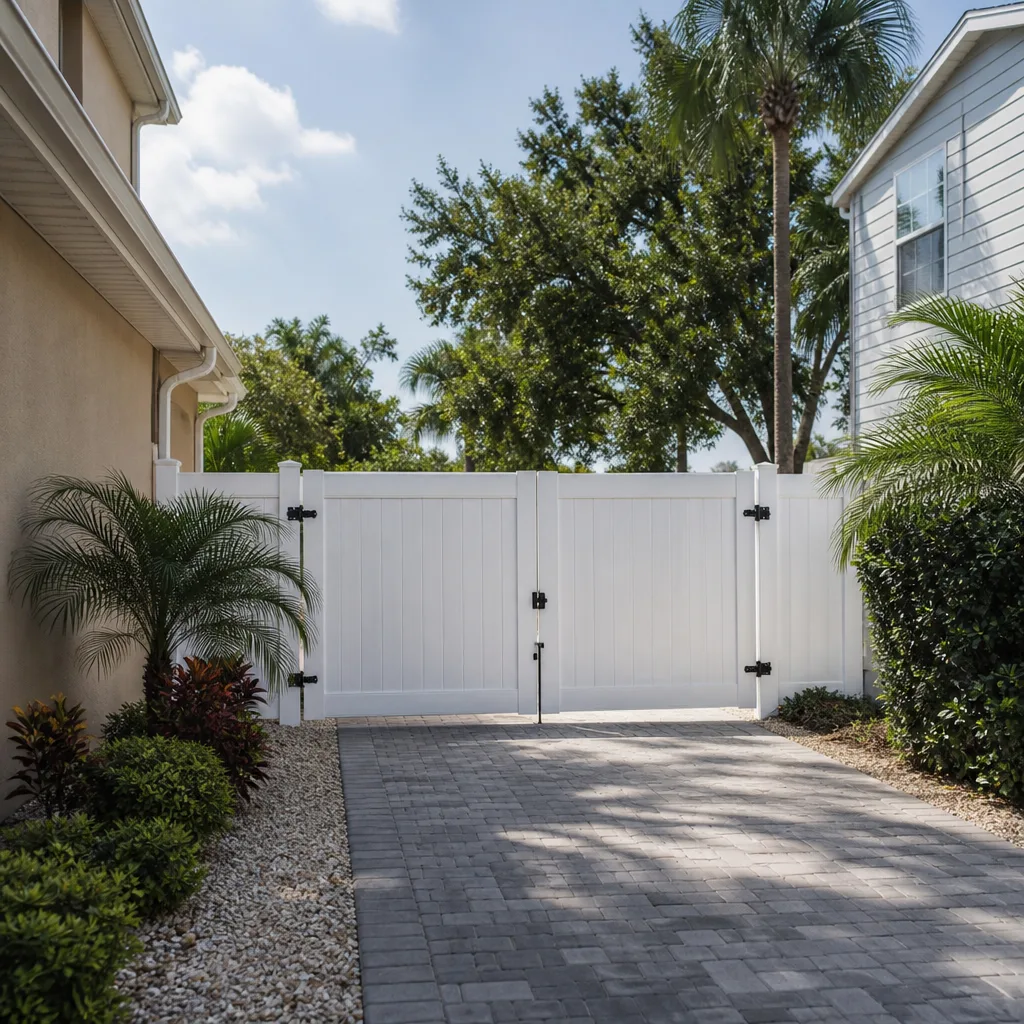
- Gate swing. The gate should swing freely, latch cleanly, and sit level with no drag. If it already rubs the ground on day one, it’ll get worse.
- Footings. Concrete should be domed and intact, not cracked, dished, or missing around any post.
- Clean termination. Rails should be capped where the fence ends, and fasteners should be set flush, not protruding.
Here’s what a finished fence shouldn’t do: it shouldn’t lean, it shouldn’t wobble when you push a corner post, and it shouldn’t have gates that drag or hardware that flexes. If it fails the push test, ask questions before you sign off.
The 730-Day Done Right Promise exists for exactly this reason. If something isn’t right at the walkthrough or shows up within two years, it gets made right. That’s the standard a fence should be held to. Paver and hardscape work along the same property line should meet the same bar, which is why the Driveway & Pavers in Henderson service follows the same guarantee.
The Questions That Expose a Shortcut Crew
The fastest way to separate a craftsman from a shortcut crew is to ask the questions that a professional answers without hesitation. Ask these before you sign, and listen to how the answers come back. Confident, specific answers are a good sign. Deflection and vague reassurance are not.
The interview questions worth asking:
- Will you pull the permit and handle the inspection through the City of Henderson?
- How deep will you set the posts, and what concrete mix do you use?
- How do you handle utility locates, and who schedules them?
- Do you verify the property line against the survey or plat?
- What brand of material and gate hardware are you installing?
- What does your written warranty cover, and for how long?
- What’s your process for tear-out and disposal of the old fence?
A pro answers all seven in a normal conversation. A crew that fumbles the permit question or the post-depth question is telling you exactly how the job will go once you’re not watching. If you want a free estimate and a straight conversation about any fence project, you can also ask what a single-contractor relationship looks like across a bigger scope, including additions covered under Home Additions & ADU in Henderson.
Common Mistakes to Avoid
- Chasing the lowest per-foot price. The cheapest bid is often the one that skips the permit, the survey, and the concrete dome. When comparing quotes, compare what’s actually included, not just the number at the bottom.
- Skipping the utility locate. Digging before the 811 flags are in place risks a severed irrigation line or a live circuit. It’s free and required, and a pro never skips it.
- Trusting the old fence as the property line. Fences drift over the years, and building on the wrong side of the line makes the dispute your problem. Verify against the plat or survey.
- Letting panels go on wet concrete. This single shortcut causes more leaning fences than anything else. If the crew starts hanging before the footings cure, stop them.
- Ignoring Henderson’s caliche when setting posts. A post that sits on top of the hardpan holds water and rots from the base. Depth and drainage matter more here than in softer soil.
- Signing off without a gate test. Open the gate, swing it, latch it. A gate that already drags on day one will sag worse by summer.
- Accepting a verbal warranty. A handshake covers nothing. Get the warranty in writing, with the covered period spelled out.
Groundwork Construction Co. of Henderson builds every fence to meet these checkpoints, and stands behind it with the 730-Day Done Right Promise, one of the longest workmanship guarantees in the residential construction space. If you’re also thinking about a larger project, our Groundwork Construction Co. of Henderson home page lays out every service line from foundation to finish line.
When to Call a Professional
Some fence problems are genuinely worth a professional call. If the property line is unclear, if the ground is hard caliche or you’re not sure what’s buried, if you need a permit and don’t know the local height rules, or if an existing fence is leaning and the footings are suspect, call in a pro. Digging around unknown utilities and setting posts into hard ground are the exact places where doing it yourself goes wrong expensive and slow. Groundwork Construction Co. of Henderson offers free estimates in Henderson, uses background-checked, uniformed technicians, and answers calls with a live person 24/7. Call (844) 320-6757 to schedule your free estimate.
See the difference
 Before
 After
 Before
 After
 Before
 After
Frequently Asked Questions
The biggest warning sign is a contractor who won’t discuss permits, utility locates, or post depth in plain language. Those three answers tell you whether the job will be built to last or built fast, and a pro covers all of them without being asked. If the answers are vague or deflected, get a second estimate before you commit. Call (844) 320-6757 for a straight conversation about any fence project.
Fence posts in Henderson should be set well below grade, deep enough to reach stable soil beneath the caliche layer, typically at least one-third of the above-grade height or more depending on the material. The caliche hardpan traps water, so shallow posts sitting on top of it rot from the base. Ask your contractor for the exact depth and concrete mix before work starts. Call (844) 320-6757 to get a quote with those specifications spelled out.
Many fence installations in Henderson require a permit, and it depends on the fence height, location on the lot, and any HOA rules for your community. A contractor who waves off permits is a red flag, because the permit and inspection protect you, not them. Confirm the requirement before digging. Call (844) 320-6757 and we’ll walk you through what your project needs.
Fence installation cost in Henderson depends on material, linear footage, post depth, tear-out of the old fence, and whether a permit is required, which is why a line-item written quote matters more than a per-foot number. Upfront pricing means the number you see is the number you pay, with no change-order surprises. Call (844) 320-6757 for a free estimate with a full breakdown. Estimates are free.
A proper fence warranty covers workmanship, meaning the posts, footings, and installation, plus the material defects the manufacturer stands behind. It should be in writing, with the covered period stated clearly. Our 730-Day Done Right Promise means if something isn’t done right, we make it right. Call (844) 320-6757 to ask what the warranty covers on your specific fence material.
Leaning panels after installation usually trace back to one of two shortcuts: panels hung before the concrete cured, or posts set too shallow in Henderson’s caliche soil so water pooled at the base. Both are preventable with the right depth, mix, and cure time. If your new fence is already leaning, get it inspected before the problem spreads. Call (844) 320-6757 for a free estimate on repairs.
The Bottom Line
The real fence installation warning signs are the things a contractor says, or won’t say, before the job starts. A crew that skips permits and utility locates, sets shallow posts in caliche, hangs panels on wet concrete, and can’t answer a question about property line verification is telling you how the job will go. Hold your contractor to the specific checkpoints in this guide: depth, mix, bracing, cure time, and even gaps at the final walkthrough. Groundwork Construction Co. of Henderson builds to those standards and backs them with the 730-Day Done Right Promise, and we’ll put the pricing in writing before any work starts.
Ready for a straight, line-item estimate? Call Groundwork Construction Co. of Henderson at (844) 320-6757 for a free estimate, and get a fence that’s built to last and backed in writing.
Written by the team at Groundwork Construction Co. of Henderson.